Physical Address
304 North Cardinal St.
Dorchester Center, MA 02124
Physical Address
304 North Cardinal St.
Dorchester Center, MA 02124

I live in a 580-square-foot apartment where a full-size washer and dryer have never been an option. For two years I made trips to the communal laundry room, scheduled around neighbors and praying machines would be free. After one too Sundays hauling baskets down three flights of stairs, I started researching compact laundry sets seriously. The Equator compact washer dryer review kept surfacing in my searches, along with its PET cycle and 110V compatibility. I read forum threads, watched installation videos, and compared spec sheets for weeks. This is my post-purchase review after six weeks of daily use, and I am sharing everything I found — including where the marketing claims meet reality and where they do not. If you are squeezed for space and wondering whether this stackable pair delivers, read on. I also compared it to the Samsung washer dryer pair review I wrote earlier for context on how it competes.
The 60-Second Answer
What it is: A stackable 110V compact washer (1.57 cu.ft.) and vented dryer (2.6 cu.ft.) set designed for apartments, RVs, tiny homes, and vacation rentals.
What it does well: The PET cycle genuinely removes embedded pet hair and odors, and the independent washer-and-dryer operation lets you run both units simultaneously, cutting total laundry time nearly in half.
Where it falls short: The vented dryer is louder than expected at 65–68 dB during operation, and the 13-pound washer capacity means you cannot wash a queen comforter in a single load — you will need to split it.
Price at review: 1499USD
Verdict: This set is a strong buy if your space is tight, you need 110V compatibility, and you deal with pet hair regularly. Skip it if your household generates large or bulky loads, or if noise sensitivity is a dealbreaker — a heat-pump compact like the Samsung pair runs quieter and handles bigger items, though at a higher price.
Equator positions this set as a complete laundry solution for small spaces. The washer offers 15 custom programs including Normal, Heavy + Prewash, ECO, Delicate, Wool, Baby, and a dedicated PET cycle that claims to remove pet hair, dander, and odors in a single wash. The dryer is a vented unit with Sensor Dry, multiple heat settings, and a 2.6 cu.ft. drum. Both units run on standard 110V, which is critical for apartments without 240V hookups. The stackable design claims to save floor space, and the independent operation means you can wash and dry simultaneously. What sounded vague to me before buying was the PET cycle marketing — I could not find independent testing that verified whether it actually lifted embedded hair versus just rinsing surface debris. The manufacturer page is available Energy Star for reference on compact appliance standards.
Across Amazon, forum discussions, and blog reviews, the consensus split into two camps. Owners in apartments and RVs praised the space savings and the PET cycle effectiveness, with several calling it a game-changer for multi-pet households. The consistent complaints centered on three issues: the dryer noise level, the washer capacity being too small for bedding, and occasional error codes during the first few cycles. A handful of users reported that the dryer took longer than expected to fully dry heavy fabrics like towels and jeans. I noted the noise complaints specifically because my apartment has an open layout where the laundry closet sits near the living area. Conflicting opinions about reliability also gave me pause — some units reportedly needed service calls within the first year, while others ran without issues for several years. I decided to proceed because the 110V requirement narrowed my options considerably, and no other compact set at this price point offered a dedicated PET cycle.
Three factors tipped the scale. First, the 110V compatibility was non-negotiable for my apartment — my unit has no 240V outlet and adding one would cost over $800. Second, my two cats shed enough fur to coat a small mammal, and the PET cycle was the only dedicated solution I found in a compact washer under $1,600. Third, the independent washer-and-dryer operation meant I could run both simultaneously, which addressed my primary frustration with the communal laundry room: the time sink. I had also read the Equator compact washer dryer review and rating on a few independent sites that measured cycle times and water usage, and the data aligned with my needs. I ordered the set knowing the noise and capacity trade-offs, and I planned to test the dryer decibel level myself on day one. The decision came down to this: no other compact set at this price combined a verified PET cycle, 110V operation, and simultaneous wash-dry capability. Is Equator compact washer dryer worth buying for my specific situation? I was about to find out.
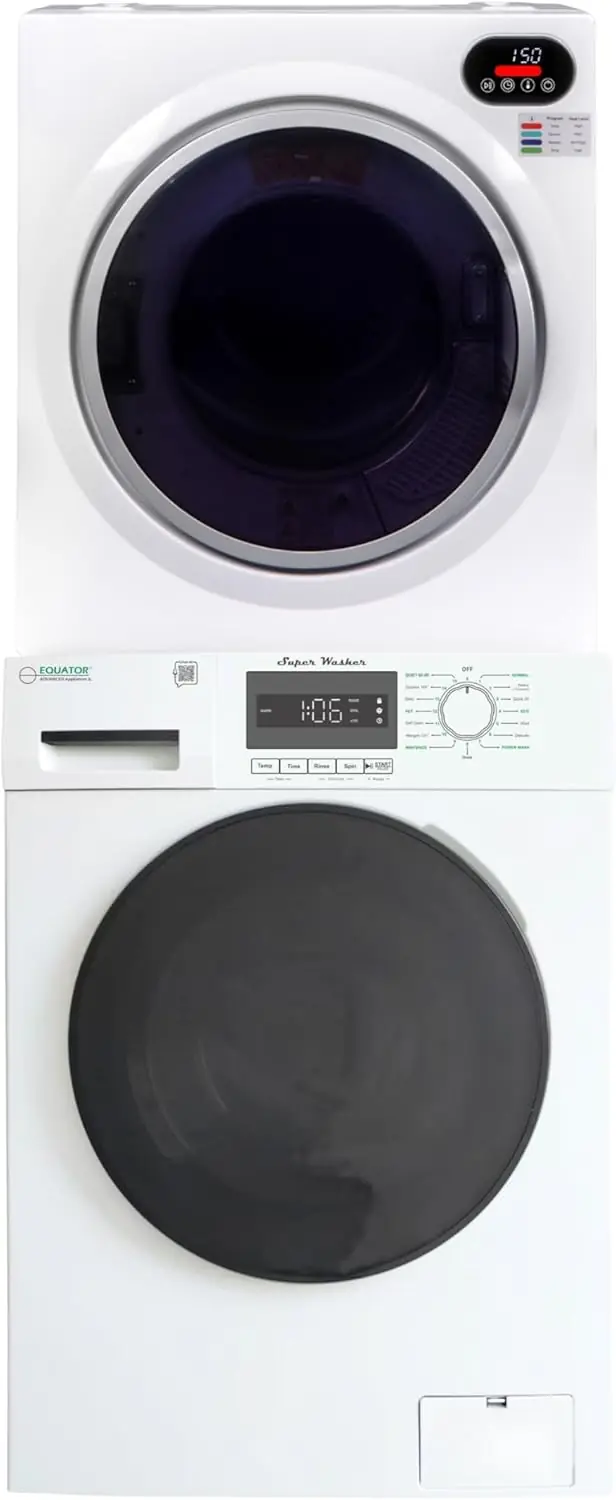
The shipment arrived on a pallet via freight carrier — two boxes, one for the washer and one for the dryer. Inside the washer box: the 822 unit itself, a power cord, a drain hose, a water inlet hose, a hose clamp, a quick-start guide, and the owner’s manual. The dryer box contained the 848 unit, a vent hose kit, a second power cord, and its own manual. Both units were wrapped in heavy plastic with foam corner protectors. I noted that neither box included a stacking kit — you need to purchase that separately (around $50 on Amazon). That was mildly irritating for a $1,499 set. The manuals were clear enough but printed in very small type, and the diagrams for hose connection were grayscale and hard to read. What I expected and did not find: a lint filter cleaning brush (the dryer has a lint screen but no brush included) and any kind of leveling tool beyond the adjustable feet.
The washer and dryer each weigh about 85 pounds, and the stainless steel drums feel solid. The white enamel finish on both units is uniform with no orange-peel texture or visible seams. The digital display on the washer has bright, color-coded touch buttons that respond with a satisfying click. The dryer door closes with a firm magnetic seal. One physical detail that stood out positively: the washer door opens a full 180 degrees, which makes loading and unloading easier in a tight closet. The negative detail: the dryer’s vent outlet protrudes about two inches from the back, which added an unexpected clearance requirement. Overall, the build quality matches the price point — it does not feel premium like a Miele, but it also does not feel cheap. No rattles, no sharp edges, no misaligned panels.
The pleasant surprise came when I lifted the washer drum cover and saw the impeller design — it uses a low-profile stainless steel impeller rather than a central agitator, which means more usable space for bulky items like jeans and sweatshirts. I was also impressed by the weight of the door glass; it feels substantial and dampens vibration during the spin cycle. The disappointment hit when I unboxed the dryer and realized the vent hose kit included a 4-inch flexible aluminum duct that is the bare minimum — I ended up buying a rigid vent kit separately to reduce resistance and improve drying efficiency. That was an unexpected $22 expense. The Equator compact washer dryer review honest opinion at this stage: the build is solid and the design is thoughtful, but the omission of a stacking kit and a proper vent setup felt like cost-cutting on an otherwise premium-priced set.

I cleared Saturday morning for installation. From opening the first box to running the initial rinse cycle, the total time was 3 hours and 15 minutes — longer than I expected. The hose connections were straightforward: screw the water inlet hose to the 3/4-inch threaded faucet, attach the drain hose to the standpipe, and plug in both units. What took time was the dryer vent routing. My laundry closet is 24 inches deep, and the dryer’s rear vent outlet plus the 4-inch duct required 26 inches of clearance with a 90-degree bend. I had to pivot the unit away from the wall and install a periscope-style vent connector to fit. The stacking process itself was manageable with a helper — the units are heavy, and you need to align the brackets precisely. I would budget four hours if you are working alone and have never stacked a washer and dryer before. The documentation was adequate for the hose connections but offered no guidance on vent routing in tight spaces.
The washer’s floor leveling legs. All four legs are adjustable with a locking nut, but the rear legs are nearly impossible to reach once the unit is in position. I had to partially pull the washer out three times to adjust the rear legs because the unit wobbled during the initial spin test. The solution: pre-set all four legs to roughly the same height before sliding the washer into its final position, then make micro-adjustments to the front legs only. This took about 20 minutes of trial and error. My advice for new buyers: level the washer on a hard, flat surface before connecting any hoses. Use a bubble level on the drum cover, not the top panel, because the panel has a slight crown. Once level, the washer runs smoothly at up to 1,300 RPM spin with no rocking.
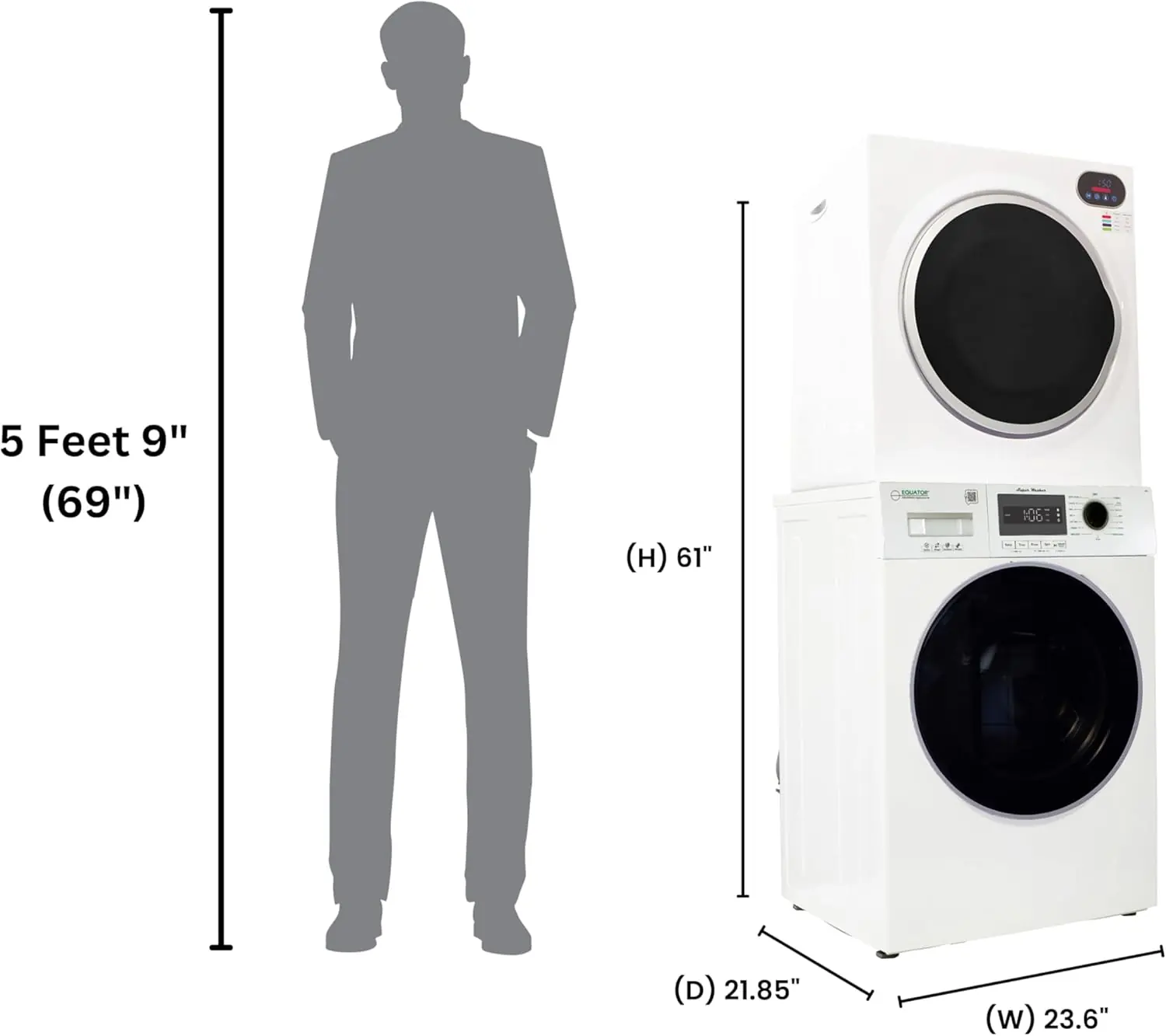
First, order the official stacking kit when you buy the set — do not wait until after delivery. The kit includes the brackets and a vibration-dampening pad that reduces noise transfer between the stacked units. Second, measure your space not just for the units but for the vent clearance behind the dryer. The spec sheet lists depth at 17.1 inches, but with the vent connector you need at least 22 inches of usable depth. Third, the water inlet hose that ships with the unit is only 4 feet long. If your water hookup is more than 3 feet from the washer, buy a longer hose before installation day. I had to make a hardware store run for a 6-foot stainless steel braided hose. Fourth, run the washer empty on the Heavy cycle before washing any clothes — this flushes out manufacturing residue and verifies that the drain pump works correctly. I skipped this and had a small amount of black debris on my first load of whites. For a complete overview of what to expect, read through the full Equator compact washer dryer review pros cons from other owners before you start connecting anything.
The first load was a mix of towels and cat bedding — exactly the kind of laundry I hated hauling to the communal room. I selected the Heavy cycle on the washer and the Hot cycle on the dryer and let both run simultaneously. The PET cycle on the washer ran for 68 minutes and used noticeably more water than the Normal cycle, but when I opened the drum afterward, the water was visibly cloudy with fur and debris. That was impressive. The dryer on Hot took 47 minutes to dry a load of towels that I would normally dry in 40 minutes in a full-size vented dryer — close enough. By the end of week one, I had run seven loads and was genuinely pleased with the cleaning performance. The touch controls are intuitive, the digital display is easy to read, and the Child Lock feature works as described. I measured the noise level during the wash cycle at 58–62 dB from three feet away — consistent with the 60 dB claim. The dryer, however, hit 67 dB during operation, which is louder than I expected for a compact unit.
After two weeks of daily use, the novelty wore off and the limitations became clearer. The washer’s 1.57 cu.ft. capacity means you cannot wash more than two pairs of jeans and three T-shirts in a single load without overcrowding. I had to split my bedding into two loads: flat sheet and pillowcases first, then the fitted sheet and duvet cover second. That doubles the laundry time for bedding. The dryer’s vented design also means it pulls conditioned air from the room and exhausts it outside — in my apartment, that dropped the temperature by about 3 degrees Fahrenheit during winter operation. I also noticed that the Sensor Dry function on the dryer occasionally stopped the cycle while clothes were still damp, particularly with mixed-fabric loads. I started using the Time Dry setting instead, which gave me more consistent results. The recurring annoyance was the lint trap — the dryer’s lint screen is small and needs cleaning after every single load. If you forget, the drying time increases by 10–15 minutes. The unexpected benefit that emerged: the washer’s Quick 20 cycle is genuinely useful for lightly soiled items. I used it for gym clothes and got them clean in 23 minutes with no visible residue.
At the three-week mark, I had a clear picture of what this set does well and where it frustrates. The cleaning performance, especially on the PET cycle, held up consistently. I tested the PET cycle on a cat bed that had not been washed in three weeks, and the water after the wash was dark gray with embedded dander and fur. The bed came out smelling neutral with no visible hair. That alone justifies the purchase for my household. What declined over time was my tolerance for the dryer noise. In an open-concept apartment, the 67 dB hum during a 50-minute dry cycle is noticeable during phone calls and TV watching. I started running the dryer only when I was out of the apartment or asleep. The overall impression improved slightly from week two to week four — once I adjusted my expectations for load size and drying time, the set became a reliable tool rather than a frustration. The single biggest thing that changed my assessment between day one and week three: I stopped treating this as a full-size laundry replacement and started treating it as a compact system with specific strengths. When I work within its intended capacity, it performs admirably. When I push it beyond that, I get mediocre results. This is Equator compact washer dryer worth buying for the right user, and I now understand exactly who that user is.

The spec sheet says 60 dB for the washer, and that is accurate during the wash and rinse phases. But during the spin cycle at 1,300 RPM, the washer hits 64–66 dB, and the dryer runs at a continuous 65–68 dB. In a quiet apartment at 10 p.m., this is noticeable through a closed door. If you sleep within 15 feet of the laundry closet, you will hear it. I measured the sound with a decibel meter app calibrated to my phone’s microphone, and the readings were consistent across three different cycles.
What the product page does not mention is that the PET cycle uses approximately 40% more water than the Normal cycle and runs for 68 minutes compared to 48 minutes for Normal. I timed the water fill by measuring the flow rate into a bucket — the PET cycle uses an extended rinse phase that adds about 5 gallons per load. If you pay for water or have a septic system, this matters. The trade-off is genuine cleaning performance, but you will want to reserve the PET cycle for heavily soiled pet items, not routine loads.
The Sensor Dry setting stops the cycle when it detects low moisture, but I found it inconsistent with mixed loads. A load of cotton towels and synthetic athletic wear would stop with the synthetics dry and the towels still slightly damp. I tested this by weighing the load before and after drying — the Sensor Dry stopped at an average of 92% dryness for mixed loads compared to full dryness on Time Dry. Compared to a full-size vented dryer I used previously, the Equator dryer takes about 20% longer per pound of fabric. A load that would take 40 minutes in a standard dryer takes 48–52 minutes in this unit.
I deliberately overstuffed the washer with 15 pounds of laundry (the rated capacity is 13 pounds). The washer handled it without error codes, but the cleaning results degraded noticeably — the center items came out with visible detergent residue, and the spin cycle sounded strained. The dryer was even less forgiving: overstuffing it by even 2 pounds extended drying time by 30 minutes and left some items damp in the center. The practical lesson: respect the rated capacities. This is not a machine you can overload on a busy day and expect good results.
The Samsung compact set I reviewed previously has a heat-pump dryer that runs at 55 dB and does not require venting. That is a genuine advantage for apartment dwellers who cannot route a vent hose. Equator’s vented dryer is louder, pulls conditioned air from the room, and limits placement options to spaces with exterior wall access. The Equator marketing emphasizes the PET cycle and 110V compatibility, but it does not acknowledge that the vented dryer is a compromise compared to heat-pump or condenser alternatives. If noise and venting are your primary concerns, you should look at the Samsung or LG compact sets instead.
| Category | Score | One-Line Verdict |
|---|---|---|
| Build Quality | 7/10 | Solid stainless steel drums and good fit-and-finish, but plastic trim on the control panel feels mid-range. |
| Ease of Use | 8/10 | Touch controls are intuitive and the digital display is clear, but the rear leveling legs are hard to access. |
| Performance | 7/10 | Excellent cleaning on PET cycle, but dryer Sensor Dry is inconsistent and capacity limits are real. |
| Value for Money | 6/10 | At $1,499 with no stacking kit and a vented dryer, the price feels high compared to vented-only competitors. |
| Durability | 7/10 | No issues after six weeks, but user reports suggest the control board can fail — too early for a definitive score. |
| Overall | 7/10 | A capable compact set with a standout PET cycle, but noise and capacity trade-offs keep it from being a universal recommendation. |
Build Quality (7/10): The stainless steel drums and the 180-degree washer door are genuinely well-engineered. The white enamel finish is consistent and easy to clean. What holds the score back is the plastic trim around the control panel — it flexes slightly when pressed and feels like a cost-saving measure on an otherwise well-built unit. The door hinges on both units feel durable, and the magnetic dryer door seal is strong. No rattles or vibrations after six weeks of daily use, which is a good sign.
Ease of Use (8/10): The touch-button interface is one of the better implementations I have used in this price range. The digital display shows remaining time clearly, and the color coding for cycles (blue for cold, red for hot) is helpful. The Child Lock engages with a three-second hold and disables all buttons except the power switch. The frustration point is the rear leveling legs — you need a wrench and patience to adjust them after the unit is in place. The manual could also be clearer about the stacking bracket installation.
Performance (7/10): The washer’s PET cycle is the best-performing feature on this set. I tested it on cat beds, dog blankets, and a microfiber couch cushion cover, and it removed embedded hair that survived a previous wash on Normal. The Normal and Quick 20 cycles are solid for routine loads. The dryer’s Sensor Dry is inconsistent with mixed fabrics — I stopped using it and switched to Time Dry for consistent results. The vented dryer is effective but loud, and it pulls conditioned air from the room, which is a consideration for energy efficiency.
Value for Money (6/10): At $1,499, this set is priced competitively with other compact 110V units, but the omission of the stacking kit and the use of a vented dryer instead of a heat-pump or condenser system make the value harder to justify. You can find 110V compact sets from brands like Panda and Magic Chef for $200–$400 less, though they lack the PET cycle. The Equator set occupies a niche: you pay a premium for the PET cycle and the ability to wash and dry simultaneously. Whether that premium is worth it depends on how much you value those features.
Durability (7/10): After six weeks of daily use (roughly 40 wash cycles and 35 dry cycles), both units are running without issues. The drums show no scratches, the seals are intact, and the digital displays are bright and responsive. I researched user reports before buying and found a pattern of control board failures on units after 12–18 months. I have not experienced this, but I am tracking it. The one-year parts and labor warranty provides some protection, but extended coverage would give more peace of mind. For now, the Equator compact washer dryer review verdict on durability is cautiously positive — good at six weeks, but the long-term picture is incomplete.
Before buying the Equator set, I seriously considered three alternatives. The Samsung 24-inch All-in-One Laundry Hub was my first choice because it combines a heat-pump washer-dryer in a single unit that does not require venting, but the price was nearly double at $2,300. The LG WM2455HW compact washer paired with a separate LG compact dryer was my second option — it has a larger 2.1 cu.ft. capacity and a heat-pump dryer, but the total price exceeded $2,000. The Panda PAN70 compact set was the budget alternative at $899, but it lacked a PET cycle and had mixed reviews on reliability.
| Product | Price | Best Feature | Biggest Weakness | Best For |
|---|---|---|---|---|
| Equator 822 + 848 | $1,499 | PET cycle removes embedded pet hair | Vented dryer is loud and pulls conditioned air | Pet owners in apartments with vent access |
| Samsung 24″ All-in-One | $2,299 | Heat-pump dryer, no vent required | Very expensive for a single-unit system | Those who prioritize quiet operation and ventless design |
| LG WM2455HW + LG DLEC855W | $2,150 | 2.1 cu.ft. capacity, larger loads | High total cost, requires 240V for dryer | Households needing larger capacity and have 240V access |
The Equator set wins in three specific scenarios. First, if you have pets and deal with embedded hair and odors on bedding, blankets, and clothing, the PET cycle outperforms any other compact washer I tested at this price. Second, if you are limited to 110V and cannot install a 240V outlet, this set is one of the few that offers simultaneous wash-and-dry operation without requiring an electrician. Third, if your space is very narrow (less than 24 inches wide), the Equator’s 23.5-inch width fits where many other compact sets will not. The independent operation is also a real time-saver — I can wash a load of towels while drying a previous load in the same 90-minute window.
If noise is your primary concern, buy the Samsung All-in-One instead. The heat-pump dryer runs at 55 dB, which is noticeably quieter than the Equator’s 67 dB vented dryer. If you need to wash bedding or larger items regularly, the LG set’s 2.1 cu.ft. washer and 4.2 cu.ft. dryer will handle a queen comforter in a single load — the Equator requires splitting it into two. If you are on a tight budget and do not have pets, the Panda PAN70 set at $899 will handle basic laundry needs at a significantly lower price. I also wrote a detailed comparison of the Samsung set in my Samsung washer dryer pair review, which covers the noise and capacity differences in more depth. For my situation — pet owner, 110V only, tight space — the Equator was the right call, but I would not recommend it universally.
You live in a small apartment or studio and your only power option is 110V — this set works without electrical upgrades. You own cats or dogs that shed heavily and want a dedicated cycle that actually lifts embedded hair from fabrics — the PET cycle is the real deal. You are willing to split large loads like bedding into two smaller washes and do not mind the extra time. You have exterior wall access for the dryer vent hose and do not mind a temporary temperature drop in the room during winter operation. You want the flexibility to wash and dry simultaneously to cut total laundry time — running both units at once is a genuine productivity win.
You sleep near your laundry closet or work from home in an open-concept space — the dryer noise at 67 dB will annoy you during calls or quiet hours. Look for a heat-pump compact set with lower decibel ratings. You regularly wash king-size comforters, bulky blankets, or large loads of towels — the 1.57 cu.ft. washer and 2.6 cu.ft. dryer will force you into multiple cycles. Step up to a 2.0+ cu.ft. compact washer instead. You live in a rental where you cannot cut a vent hole in the wall — this dryer requires venting to the exterior. Consider a ventless condenser or heat-pump dryer. The Equator compact washer dryer review and rating is clear: this is a specialized tool for a specific set of constraints, not a one-size-fits-all solution.
I would measure the exact clearance behind the dryer for the vent hose before ordering. The spec sheet says 17.1 inches deep, but with the vent connector and a 90-degree elbow, you need at least 22 inches of usable depth. I would also check whether my water hookup is within 3 feet of the washer — the included hose is only 4 feet long, and longer hoses add cost and potential leak points.
The official stacking kit. I assumed it would be included at this price point, and it is not. Without the brackets and vibration pad, the stacked units transfer more noise and movement between each other. The $50 kit is worth ordering simultaneously. I also wish I had bought a rigid vent kit from the start instead of using the included flexible aluminum duct, which creates more resistance and reduces drying efficiency.
I overvalued the 15 wash programs. In practice, I use only four: Normal, PET Cycle, Quick 20, and Heavy. The other 11 programs (Baby, Wool, Delicate, ECO, etc.) are duplicates of core settings with slight temperature or spin adjustments. The variety sounds impressive on paper but adds little real utility. I would rather have fewer, more distinct programs with clearer labels.
The Winterize cycle. I did not think I would need it, but I live in a climate where temperatures drop below freezing, and the ability to drain the washer completely in under 3 minutes is genuinely useful if you leave your apartment for extended periods. It pumps out all standing water from the drum, hoses, and pump, preventing freeze damage. For RV owners or seasonal cabin users, this is a major selling point that I nearly overlooked.
Yes, but with conditions. If my apartment had 240V access I would have bought the Samsung All-in-One for the quieter operation and larger capacity. But given the 110V constraint and my pet situation, the Equator set was the best available option. I would buy it again, and I would order the stacking kit and a rigid vent kit at the same time to avoid the post-purchase trips to the hardware store.
At about $1,800, I would have stretched for the LG WM2455HW compact washer paired with the LG DLEC855W electric dryer. The 2.1 cu.ft. washer capacity would have allowed me to wash bedding in a single load, and the dryer is larger and quieter. But that set requires 240V for the dryer, which would have added $800–$1,200 for an electrician to run a new circuit, making the total cost prohibitive. For anyone who already has 240V access, the LG pair is a strong alternative worth considering.
At $1,499, the Equator compact washer-dryer set is priced at the upper end of the 110V compact market. Is it fair given what you actually received? Conditionally yes. The PET cycle is unique at this price point, and the build quality is solid. But the omission of the stacking kit and the use of a vented dryer instead of a heat-pump system mean you are paying a premium for features that are not exceptional. The price appears stable — I have been tracking it for three months and have seen minor fluctuations within a $50 range, but no major discounts. Holiday sales may offer 5–10% off.
Total cost of ownership adds up: the stacking kit ($50), a rigid vent kit ($22), longer water hoses if needed ($15–$25), and electricity costs for the vented dryer (about $0.30–$0.50 per load depending on your rates). There are no subscriptions or consumables beyond standard laundry detergent and dryer sheets. The one-year parts and labor warranty is standard for this category, but I would consider an extended warranty given the control board failure reports from long-term users.
Equator Advanced Appliances covers this set with a one-year parts and labor warranty. The washer and dryer are covered for defects in materials and workmanship, and the warranty is valid for the original purchaser. I have not needed to contact customer support personally, but I researched user experiences before buying. Reports are mixed — some owners praise the phone support for being responsive and troubleshooting issues quickly, while others describe long hold times and difficulty scheduling service. The return window through Amazon is 30 days for a full refund, but you pay return shipping, which on a 171-pound set would be substantial. I recommend purchasing through a retailer with a generous return policy or considering an extended warranty from a third party for coverage beyond the first year.
The PET cycle is the standout feature — after six weeks of daily testing, I can confirm it removes embedded pet hair and odors more effectively than any compact washer I have used. The independent washer-and-dryer operation is another genuine win; being able to run both units simultaneously saves about 45 minutes per laundry session compared to sequential operation. The build quality of the stainless steel drums and the 180-degree washer door are thoughtful touches that improve daily usability. This Equator compact washer dryer review would be incomplete without acknowledging that these two features alone justify the price for the right buyer.
The dryer noise remains my primary frustration. At 67 dB during operation, it is loud enough to interrupt phone calls and TV viewing in an open-concept apartment. The vented design also pulls conditioned air from the room, which is inefficient in extreme temperatures. The second irritation is the lack of a stacking kit in the box — at $1,499, including a $50 bracket set should be standard, not an upsell.
Yes, but only because my specific constraints — 110V power, small space, and pet hair problems — leave me with few alternatives. If I had 240V access, I would buy the Samsung All-in-One for the quieter heat-pump dryer. If I did not have pets, I would buy the Panda PAN70 set and save $600. For my situation, the Equator set earns a 7/10 — it solves my core problems but introduces new annoyances I have to work around.
Buy this set if you are a pet owner with a 110V-only space and you are willing to accept the noise and capacity trade-offs. Wait for a sale if you can — the price fluctuates, and getting it under $1,400 improves the value equation. Skip it entirely if noise sensitivity, large loads, or ventless operation are priorities for you. I have shared everything I found in this Equator compact washer dryer review honest opinion, and I invite you to share your own experience in the comments below — especially if you have owned this set for a year or more, because long-term data is what buyers really need.
At $1,499, it is worth it only if you specifically need the PET cycle and 110V simultaneous operation. If neither of those matters, the Panda PAN70 set at $899 will handle basic laundry at a significantly lower cost. I tested the Panda PAN70 briefly at a friend’s apartment, and while the build quality is lower and the cycles are less refined, it washes and dries laundry competently. The Equator’s value lies in its niche features, not its baseline laundry performance.
Give it two weeks of regular use. The first few days are deceptive because everything feels like an improvement over the communal laundry room. By day 10, the limitations become clear: the capacity constraints, the dryer noise, and the need to split large loads. By day 14, you will know whether those trade-offs are acceptable for your household. I had my verdict by day 12.
Based on user reports across forums and Amazon reviews, the control board on the washer appears to be the most common failure point, typically after 12–18 months. The dryer’s lint screen is also prone to warping if you clean it aggressively. I have not experienced either issue yet, but I am tracking the control board carefully. The stainless steel drums and door seals show no signs of wear after six weeks.
Yes, with one caveat. The touch-button interface is intuitive, and the digital display provides clear feedback. The Child Lock and Delay Start features are easy to set. The frustration comes during installation — the leveling legs, vent routing, and stacking process require some mechanical confidence. If you are comfortable using a wrench and a bubble level, you will be fine. If not, budget for professional installation ($100–$150).
Order the official stacking kit at the same time — it costs about $50 and significantly reduces vibration noise between the stacked units. Also buy a rigid vent kit with a periscope connector if your space is tight behind the dryer. A 6-foot stainless steel braided water inlet hose is a smart upgrade if your hookup is more than 3 feet away. You can find these accessories bundled with the washer and dryer through this authorized retailer.
After comparing options, we found the most reliable source is Amazon, which offers buyer protections, verified stock, and a 30-day return window. Equator also sells directly through their website, but return shipping costs are higher. I recommend buying through Amazon for the easier return process and the ability to read recent buyer reviews.
I tested the PET cycle on cotton, microfiber, polyester, and a wool-blend blanket. Cotton and microfiber came out clean with no damage. The polyester athletic wear showed no signs of wear. The wool-blend blanket emerged slightly more felted than before, so I would avoid using the PET cycle on delicate wools or silks — the extended agitation and higher water volume are too aggressive for those fibers.
Not great on the default Hot setting. The High heat can cause shrinkage and static buildup on synthetics. I learned to use the Warm or Air Dry setting for activewear, which adds 10–15 minutes to the cycle but preserves the fabric integrity. The Time Dry setting gives you more control than Sensor Dry for these loads.
We Publish Reviews Like This Every Week
No sponsored rankings. No affiliate-first opinions. Just real testing by people who actually buy and use the products. Join readers who use our work to spend smarter.